
Introduction
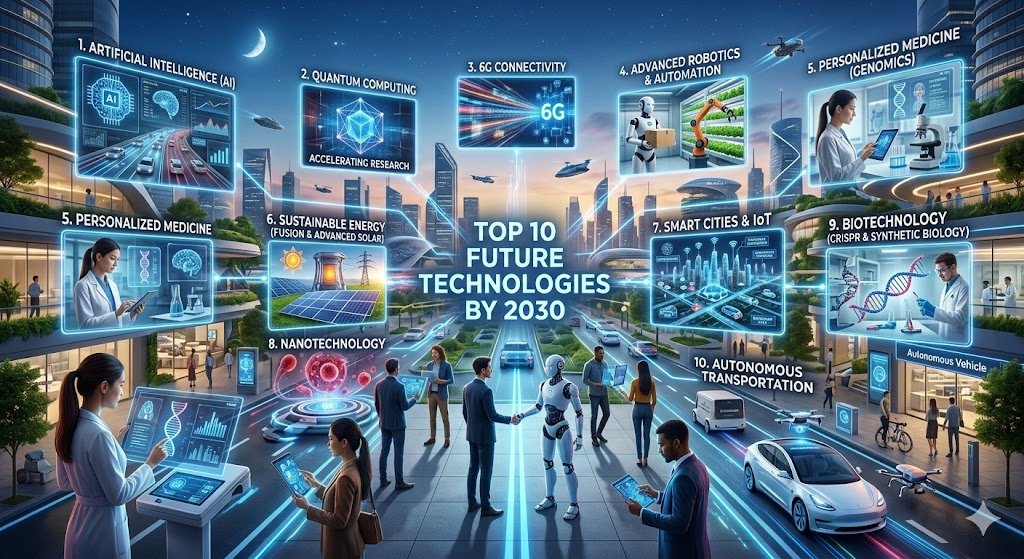
Technology has always shaped human civilization, but the speed of innovation today is unlike anything seen before. As we move closer to 2030, new technological advancements are expected to transform industries, lifestyles, and the global economy. Many technologies that once seemed like science fiction are now becoming reality, influencing how people work, communicate, travel, and even take care of their health.
Understanding future technologies is important not only for technology enthusiasts but also for students, professionals, and business owners who want to stay prepared for upcoming changes. This article explores the top future technologies that are likely to redefine human life by 2030.
1. Artificial Intelligence (AI)
Artificial Intelligence is already changing the world, but its future potential is much greater. By 2030, AI systems will become more advanced in decision-making, automation, and problem-solving.
AI will assist doctors in diagnosing diseases, help businesses analyze customer behavior, and automate repetitive office tasks. Personal AI assistants may manage schedules, finances, and daily activities with minimal human input.
AI is expected to become the backbone of nearly every industry.
2. Internet of Things (IoT)
The Internet of Things refers to connected devices that communicate through the internet. By 2030, billions of devices worldwide will be connected, creating smarter homes, cities, and workplaces.
Smart refrigerators may track food usage, traffic systems will automatically manage congestion, and wearable devices will continuously monitor health conditions. IoT will improve efficiency and reduce waste across multiple sectors.
3. Smart Cities
Future cities will use technology to improve transportation, energy use, and public safety. Smart traffic lights, automated public transport, and intelligent waste management systems will make urban living more efficient.
Sensors and AI will help governments monitor pollution levels, manage electricity consumption, and respond quickly to emergencies. Smart cities aim to create safer and more sustainable environments.
4. Autonomous Vehicles
Self-driving vehicles are expected to become more common by 2030. These vehicles use sensors, cameras, and AI to navigate roads without human control.
Autonomous cars could reduce accidents caused by human error, improve traffic flow, and provide mobility solutions for elderly and disabled individuals. Logistics and delivery industries will also benefit from automated transportation systems.
5. Robotics and Automation
Robots are moving beyond factories into everyday environments. Advanced robotics will assist in healthcare, agriculture, construction, and household tasks.
Automation will handle repetitive and physically demanding jobs, allowing humans to focus on creative and strategic work. Collaborative robots, often called “cobots,” will work alongside humans instead of replacing them entirely.
6. 5G and Next-Generation Connectivity
High-speed connectivity plays a crucial role in enabling future technology. With advanced network systems, devices will communicate faster and more reliably.
This technology will support real-time gaming, remote surgery, virtual collaboration, and smart infrastructure. Faster internet speeds will unlock innovations that require instant data processing.
7. Virtual Reality (VR) and Augmented Reality (AR)
VR and AR technologies are expected to transform entertainment, education, and training. Students may attend virtual classrooms, employees can practice skills in simulated environments, and shoppers may try products digitally before purchasing.
These immersive technologies will create new ways for people to learn and interact with digital content.
8. Blockchain Technology
Blockchain is more than just cryptocurrency. By 2030, it may play a major role in secure digital transactions, identity verification, and data protection.
Businesses can use blockchain to improve transparency in supply chains, reduce fraud, and ensure secure record keeping. Governments may also adopt blockchain systems for secure public services.
9. Renewable Energy Technology
Future technology will focus heavily on sustainability. Advanced solar panels, smart energy grids, and improved battery storage systems will make renewable energy more efficient and affordable.
Clean energy solutions will help reduce dependence on fossil fuels and support global environmental goals.
10. Biotechnology and Smart Healthcare
Healthcare is entering a new era powered by technology. Wearable devices, AI-driven diagnostics, and personalized medicine will allow doctors to detect diseases earlier and treat patients more effectively.
Biotechnology advancements may lead to faster drug development, improved vaccines, and treatments customized according to individual genetic profiles.
How These Technologies Will Impact Daily Life
By 2030, daily routines may look very different:
- Homes will automatically adjust lighting and temperature.
- Cars may drive themselves.
- Workplaces will rely heavily on automation.
- Healthcare monitoring will happen continuously through wearable devices.
- Education will become more personalized through AI systems.
Technology will not only improve convenience but also increase productivity and safety.
Challenges of Future Technologies
Despite the benefits, several challenges must be addressed:
Job Transformation: Some traditional jobs may disappear, requiring workers to learn new skills.
Privacy Concerns: Increased data collection raises questions about personal security.
Digital Divide: Not everyone may have equal access to advanced technologies.
Ethical Issues: Responsible use of AI and automation will remain a global discussion.
Balancing innovation with responsibility will be essential.
Preparing for the Future
To stay relevant in a technology-driven world, individuals should focus on learning digital skills, adaptability, and continuous education. Skills such as critical thinking, creativity, and technology literacy will become increasingly valuable.
Businesses and students who understand future trends early will have a strong advantage in the evolving global economy.
Conclusion
The technologies emerging today will shape the world of tomorrow. Artificial intelligence, smart cities, robotics, advanced connectivity, and smart healthcare are set to transform how humans live and work by 2030.
While challenges exist, the overall impact of future technology promises greater efficiency, improved health, and new opportunities. Understanding these innovations today helps individuals and organizations prepare for a smarter, more connected future.