
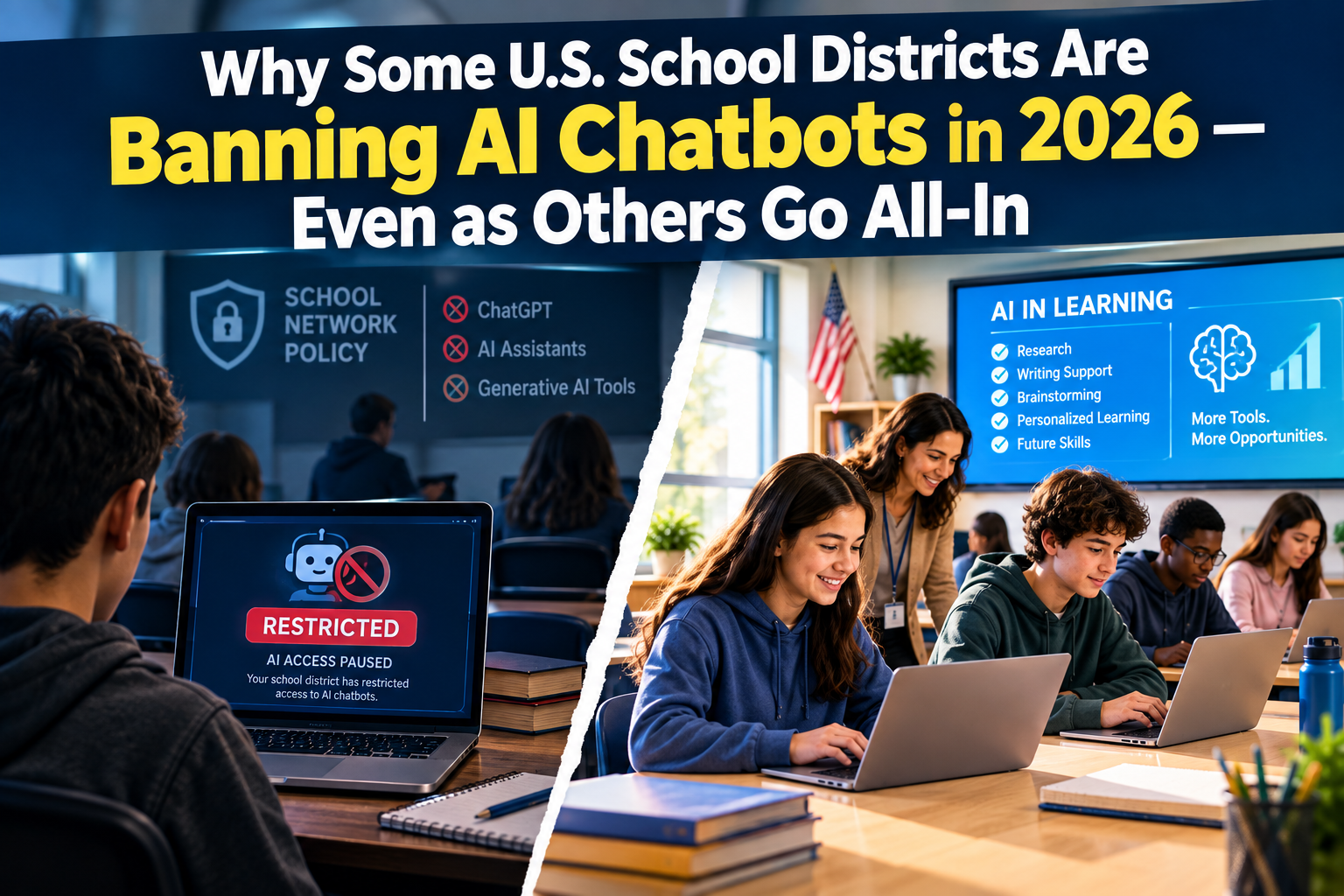
American education is having a very strange moment: two completely opposite AI strategies are playing out in classrooms at the exact same time. Some school districts are locking generative AI chat tools out of student devices entirely. Others are handing every student and staff member full institutional AI access. Both camps think they’re making the safer, smarter choice — and understanding why reveals a lot about where AI in education is actually headed.
The Ban Side: Why Some Districts Are Pulling Back
Katy Independent School District, near Houston and serving nearly 100,000 students, unveiled an AI framework at a board work session in July 2026 that bans generative AI chat tools for students. It’s not an isolated move — districts across the country are wrestling with the same core worry: that free, unsupervised access to chatbots undermines learning rather than supporting it, particularly for younger students still building foundational skills.
This concern isn’t just anecdotal. A recent Australian study found that higher-achieving students actually reported lower levels of active AI use and were more cautious about how it might affect their learning — rather than avoiding it entirely, many of these stronger students said they used AI selectively, for things like clarifying a concept or summarizing material, rather than letting it do the actual thinking.
There’s also a widening gap emerging in higher education itself. In the U.S. and Canada specifically, faculty intent to use AI has actually declined — from 76% in 2025 down to 67% in 2026 — leaving North America with the lowest future AI adoption intent of any region surveyed globally. That’s a striking reversal, and it suggests a growing wave of educator skepticism, not just administrative caution.
The Adoption Side: Why Other Institutions Are Racing Ahead
At the same time, other institutions are moving in the exact opposite direction. According to a Microsoft report, 86% of education organizations now use generative AI in some form — the highest adoption rate of any industry, which is notable for a sector that has historically been slow to adopt new technology. The global AI-in-education market reflects that momentum too: it was valued at roughly $7.57 billion in 2025 and is projected to exceed $112 billion by 2034.
Some governments are treating AI literacy as a basic requirement rather than an optional skill. A national AI literacy initiative is aiming to reach up to one million post-secondary students, offering a free three-hour course covering foundational AI knowledge, critical evaluation, responsible use, and workplace readiness — treating AI fluency the same way schools once treated basic computer literacy.
And the case for AI in classrooms isn’t purely theoretical. Education leaders point out that AI-powered instruction is expected to keep growing specifically because it reduces administrative demands on teachers and offers a real way to ease staffing shortages, at a moment when teacher workload and burnout are already serious problems.
Two Strategies, One Shared Worry
Look closely, and both the “ban it” and “adopt it everywhere” camps are actually responding to the same underlying fear: that AI could hollow out real learning if it’s used the wrong way. The disagreement isn’t about whether AI matters — it’s about whether the safer path is controlled, guided access, or no access at all until better guardrails exist.
There’s a useful signal buried in that Bank of Canada research on AI’s labor impact: rather than eliminating jobs outright, AI is more likely to reshape the tasks people actually perform, with close to one-third of jobs undergoing substantial changes under current AI capabilities. For education, that finding strengthens the case that schools need to combine AI fluency with adaptable skills, judgment, and communication — not just teach students to use a chatbot, and not just ban it and hope the issue goes away.
What This Means for Students, Parents, and Teachers
- If your school bans AI tools: That doesn’t mean AI fluency stops mattering. Building comfort with AI concepts outside the classroom — understanding what these tools are good at, where they fail, and how to evaluate their output critically — is still worth doing on your own.
- If your school is rolling out full AI access: Selective, judgment-driven use (clarifying concepts, checking your own reasoning, summarizing dense material) tends to correlate with stronger outcomes than leaning on AI to produce finished work wholesale.
- For teachers: The institutions seeing the best results are the ones pairing AI access with mandatory training and clear guardrails, not just flipping a switch and hoping students use it responsibly.
The Bottom Line
The split happening in American classrooms right now isn’t a sign that anyone has this figured out yet — it’s a sign that the education system is still actively testing what responsible AI use looks like. The districts and universities getting real value are less focused on the binary of “ban vs. allow,” and more focused on the actual behavioral question underneath: does this specific use of AI build a student’s skill, or quietly replace it?